
How to Respond to Peer Reviewer Comments | Quillcademia
Learn how to respond to peer reviewer comments effectively with our step-by-step guide. Clear reviewer objections and get your academic manuscript accepted.
Radomir Grcic
5/26/20269 min read


How to Respond to Peer Reviewer Comments
Publishing research is like a dance between authors, editors, and reviewers. In order to achieve optimal results, all sides need to be happy. Learning to respond to peer review is a difficult but necessary skill for any researcher trying to get published in a highly competitive environment. Accepting a manuscript without revision is exceptionally rare across all academic fields, making up less than 1% to 5% of eventually published papers. For journals where a major revision is issued, between 80 and 90% of papers are eventually accepted. Getting reviewer comments is not the beginning of the end, but getting closer to the beginning of acceptance.
Knowing how to respond to peer review saves time and prevents endless revision cycles. Researchers have voiced frustrations that reviewer comments can be contradictory and patronising, and even biased or unprofessional in tone. A structured, strategic approach turns a potentially grueling process into a much smoother path to publication.
What Kind of Decision Did You Actually Receive?
Before writing a single word of response, authors need to understand two separate documents: the editor's decision letter, which tells you how serious the revision is (major, minor, or rejection), and the reviewer reports, which tell you exactly what needs to change. These two do not always agree. An editor may label a decision as minor revision while a reviewer is asking for a completely new analysis, or the editor may flag language issues that no reviewer mentioned. Reading both carefully and separately is essential.
Once you have read both documents carefully, the first thing to establish is the type of decision you received. This is not just a label. The difference between a major revision and a reject with encouragement to resubmit changes how much time you have, how deeply you need to revise, and what tone your response letter should take.
Here are the main categories and what they practically mean:
Accept with minor revisions — the paper is essentially accepted. Address comments precisely, do not over-revise, turn it around quickly.
Major revision — the paper is likely to be accepted if the revisions are done well and the editor is already committed to another round of review. A thorough, professional, and point-by-point response that addresses every reviewer and editor comment is what turns a major revision into an acceptance.
Reject with encouragement to resubmit — the editor has identified clear, substantive issues but believes the paper has potential. Unlike a major revision, there is no guarantee of another review cycle and the resubmission is treated as an entirely new submission. This is where a thorough revision and a precise, point-by-point response to both the reviewers and the academic editor becomes critical. Ignored comments at this stage are almost always met with a final rejection.
Outright rejection — the paper is not suitable for this journal at this stage. Use the reviewer comments to strengthen it before submitting elsewhere. Do not ignore them.
Timelines vary depending on the publisher, as some open access journals often set much tighter deadlines than traditional publishers. However, never let a revision sit too long, even if you're not given a deadline:
Minor revision → typically 2 to 4 weeks, though timelines vary. Some journals allow up to 6 weeks, while others give as little as 5 days.
Major revision → timelines vary significantly by publisher, ranging from as little as 10 days to up to 120 days.
Reject with encouragement to resubmit → no fixed deadline, but treat it as a major revision. Aim to resubmit within 1–3 months, as letting it sit too long causes momentum to fade.
When structural or language revisions are requested by reviewers, you can streamline the process by using our professional Academic Editing Services for a complete pre-resubmission check.
How to Read the Comments
The two most common reasons papers get rejected after revision are an unclear or incomplete response to reviewers, and a manuscript that was not revised accordingly. Reading reviewer comments can feel daunting, but it becomes much easier when you approach it as a multi-step, objective process. The key is to detach emotionally, categorize the feedback, and focus on addressing substantive issues before getting into minor details.
A practical approach: read the reviews once, set them aside for a couple of days, then read them again. After that, discuss them with your co-authors to build a shared plan for how to respond.
Every comment must be addressed, but addressing a comment does not always mean changing the manuscript. The lead authors should decide together what to revise and what to defend. Revising according to reviewer suggestions is often the path of least resistance and signals openness to feedback. Disagreement is equally valid, but it needs to be backed by data, literature, or clear reasoning.
When reviewers are wrong or partially correct, a complete, well-reasoned, and polite rebuttal is entirely appropriate. Always write your response as if it could be forwarded directly to the reviewers, which editors often do when composing their decision emails.
What a Strong Response Letter Consists of
A strong response to peer review consists of two separate documents, and most authors prepare them in the wrong order.
1. Point-by-point response letter
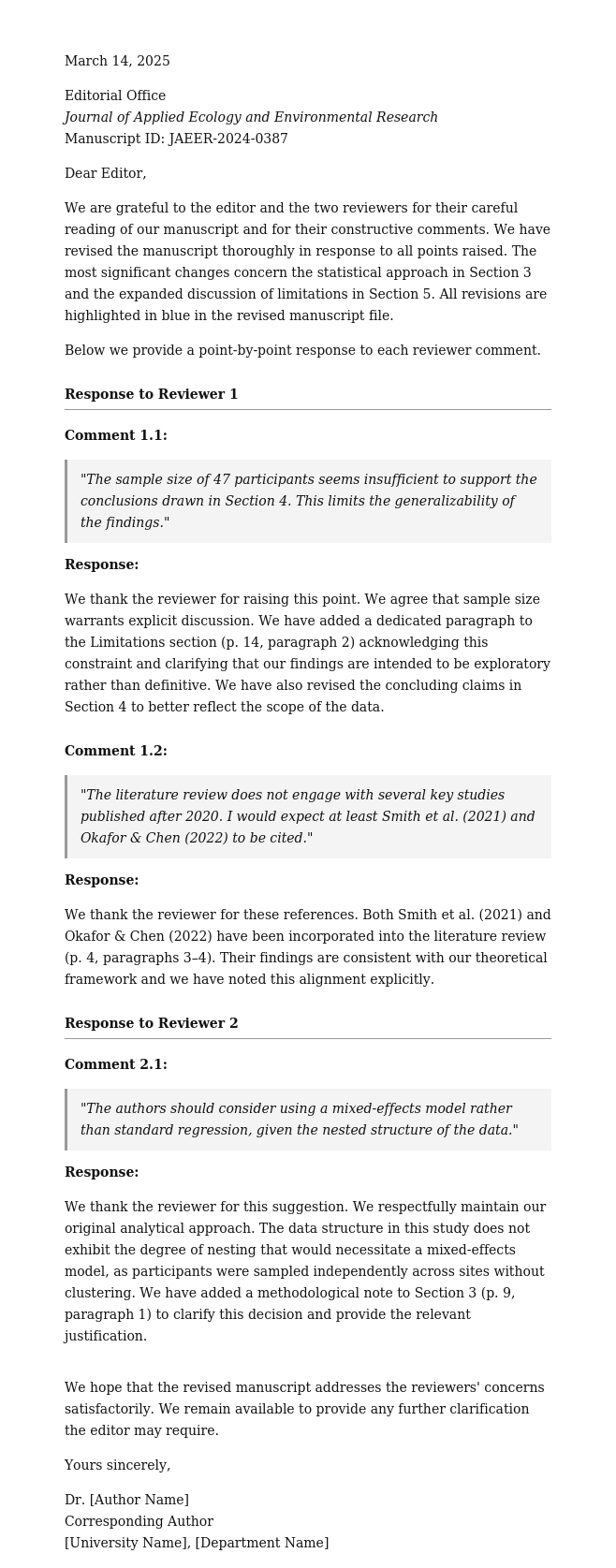
This is the most important document in the resubmission, besides the well-revised manuscript itself. Start by thanking the reviewers for their time and feedback. Follow with a short summary of the key changes made to the manuscript. The core of the letter is a structured, dialogue-style list — each reviewer comment quoted in full, followed by your direct response. For every change made, indicate exactly where it appears in the revised manuscript by page and paragraph number. For every comment you are defending rather than accepting, keep the tone professional, the reasoning clear, and support your position with verifiable arguments and cited sources.
The opening paragraph should thank the editor and reviewers briefly and genuinely, state that all comments have been addressed, and offer a one-sentence summary of the most significant changes. Do not oversell. Do not list everything in the opening.
The language register must stay formal, calm, and precise. You do not have to agree with every comment, but how you disagree determines whether the editor reads it as scholarly confidence or defensiveness.
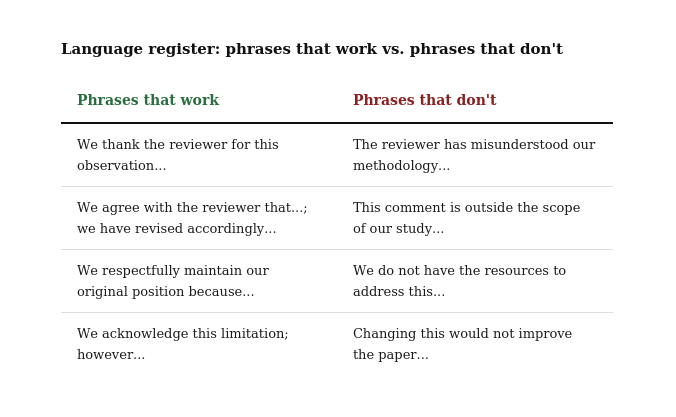
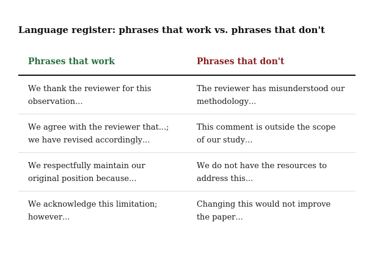
Highlight all changes in a different colour in the manuscript, and state in the letter that you have done so. Many publishers include line numbers in the manuscript. Where they do, reference the exact line number in your response so the editor can locate the relevant section without searching through the document.
2. Cover letter to the editor
This comes last. Write it right before resubmission, once the point-by-point response is complete. Its job is to summarize the changes at a high level and, where necessary, make the case for any defended points. Keep it concise. The editor has already read the detailed responses; the cover letter is an overview, not a repetition.
How to Agree and Do It Well
This is not just about saying "we agree with the reviewer and have revised accordingly." A strong acceptance of a comment shows that you understood why the reviewer raised it.
Template structure for accepting a comment:
Acknowledge the reviewer's point and what it reveals about the weakness in the original;
State what specific change you made;
Quote or paraphrase the new text (for significant revisions);
Give the location in the revised manuscript.
Changing a single sentence when the reviewer wants you to rethink the entire argument is not a real revision, and it is one of the most common mistakes at this stage.
How to Disagree Without Losing the Editor
Authors, particularly early-career researchers or those for whom English is not the first language, may find it difficult to articulate responses clearly and concisely, and this becomes most dangerous when they need to push back on a comment they genuinely believe is wrong.
Disagreeing with a reviewer is legitimate. Reviewers are sometimes mistaken, sometimes asking for things outside the paper's scope, and sometimes contradicting each other. But how you disagree determines whether the editor reads it as scholarly confidence or defensiveness.
Structure for a respectful disagreement:
Show that you understood the reviewer's concern (this is not just courtesy, it demonstrates you have actually engaged with it);
Explain your reasoning clearly, citing literature or your own data where possible;
Offer a compromise where one is available; adding a sentence to acknowledge the limitation, for example, without restructuring the entire argument;
Never respond emotionally or suggest the reviewer did not read the paper carefully.
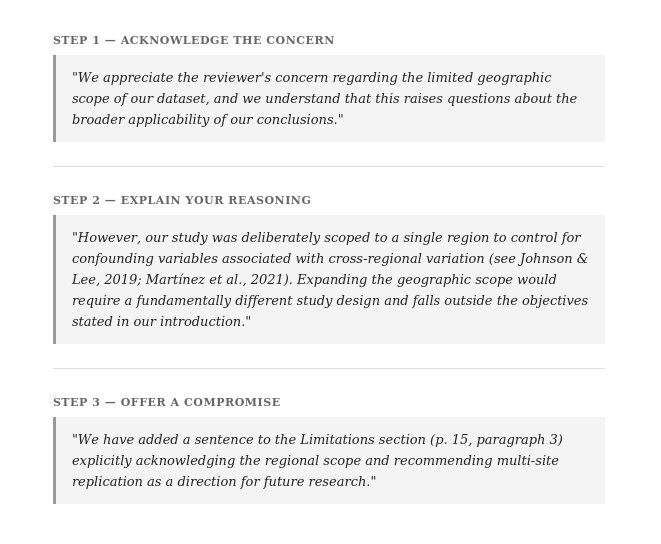
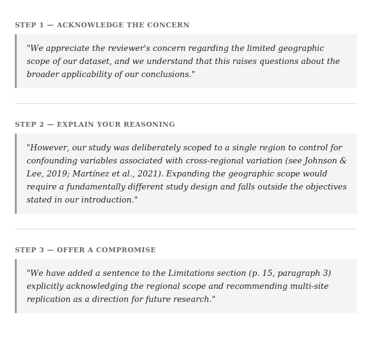
The hardest case: two reviewers contradict each other, or a reviewer contradicts the editor. This happens more often than it should. When reviewers disagree, acknowledge both positions, explain the tension explicitly, and state your reasoned decision about which direction to take. When a reviewer contradicts the editor, pay particular attention to the editor's position. The editor is the one making the final decision and has full visibility into all reviewer reports, while individual reviewers have not seen each other's feedback. Then offer a sentence in the manuscript that signals awareness of the debate. An example phrasing: "We recognize that Reviewer 1 requested additional detail while Reviewer 2 suggested reducing length. We have attempted to balance these concerns by adding methodological detail while streamlining the introduction and discussion."
The Specific Challenge for Non-Native English Speakers
The response letter is a formal academic document in its own right. It requires the same precision, tone, and argumentative clarity as the manuscript itself. A study found that non-native English speakers seek language-based feedback from colleagues for more than 75% of their publication documents, which tells you something about how much this stage matters and how much support authors are already trying to find informally. The data behind non-native English paper rejection shows just how significant this gap is.
The stakes are higher at the revision stage for non-native speakers because this is where the author has to write new text quickly in a language that is not their first, often under deadline pressure, and often while managing the emotional weight of the original criticism. There is also the opposite problem. When comments seem mild or neutral, authors sometimes assume acceptance is guaranteed and ease off, which is where mistakes happen.
What reviewers are often actually commenting on. In double-blind peer review, reviewers have no way of knowing whether a writer identifies English as their native language. Instead, they make assumptions based on institutional affiliation, and the comments on language often come from non-native writers of English themselves. Understanding this can help authors read reviewer language comments less personally and more strategically.
Two practical implications:
A comment that says "please have this reviewed by a native English speaker" is an instruction, not an insult. It needs to be addressed in the response letter, with a clear statement of what was done.
If language revision was performed, state it explicitly in the response letter. Tell the editor which sections were revised for language and that a professional editor reviewed the manuscript. This directly addresses the reviewer's concern without requiring the editor to judge for themselves.
Common Mistakes That Lose Papers at the Revision Stage
Ignoring a comment entirely. Even if you are not making the change, you must acknowledge every single comment.
Over-promising in the letter and under-delivering in the manuscript.
Responding to what the reviewer said, not what they meant.
Making revisions outside the scope of the reviewer comments. If you restructure sections not mentioned by reviewers, flag this explicitly or the editor may think you changed something they did not ask you to change.
Missing the deadline without communicating. Contact the editor early if you need more time. Most will grant an extension. Disappearing is a different matter entirely.
Submitting without re-reading the revised manuscript end to end. New revisions sometimes introduce new inconsistencies.
The revision stage feels like a test. In reality, it is the stage where your paper is closest to acceptance. Researchers who treat the response letter with the same rigour they applied to the manuscript itself are the ones who get published.
For researchers writing in a second language, the revision stage carries an additional layer of pressure. Responding to reviewer comments and revising the manuscript thoroughly simply takes more time when you are working in a language that is not your own. If you want to make sure your response letter is precise, well-toned, and clearly argued, Quillcademia's editors work specifically with academic authors at the revision stage to help you respond with confidence.
Struggling with Complex Reviewer Feedback?
Navigating major or minor revisions can be overwhelming. At Quillcademia, our expert editors help you refine both your response letter and your manuscript to meet the highest journal standards. Submit your revised abstract for a free check or contact our editorial team today.
Professional Human-Only Academic Editing Services for Researchers Worldwide
© 2026.
All rights reserved.