
The Real Data Behind Non-Native English Papers Rejection
Non-native English speakers are 2.5x more likely to have papers rejected for language. Learn the 5 writing mistakes that trigger rejection and how to fix them.
Radomir Grcic
4/28/202610 min read


The Real Data Behind Non-Native English Papers Rejection
Although English is the common language of science, it represents a major impediment to maximising the contribution of non-native English speakers to science. Since 90% of the global population is made up of people whose primary language is not English, it is underreported how big a problem this is. There is a shocking lack of insight into how much extra effort non-native English speakers must invest in order to survive and thrive in their fields. Many of them give up on their research careers early on due to this language barrier. This is a real loss for science, since every researcher who drops out takes with them perspectives and potential discoveries that the field will never see. The main tasks of a researcher involve reading papers, writing academic papers, and presenting at international conferences, and for non-native speakers, these tasks require significantly more effort than for natives. Making these hurdles visible is the first step towards achieving fair participation for scientists whose first language isn't English.
The World Is Doing the Science, but English Still Controls the Gate
The global research landscape is currently undergoing a significant shift, with substantial contributions from non-native English-speaking regions and emerging economies. Recent data indicates that institutions in China, India, Brazil, Russia, Germany and Italy have seen rising numbers of published scientific research, with China frequently dominating high-impact publication metrics with around 30% of global output. BRICS countries in general are increasing their output as well.
“English dominance is everywhere,” says interdisciplinary biologist Valeria Ramírez Castañeda, whose first language is Spanish, in an interview for Science. She shares her experience from writing a master’s thesis in Colombia and how everyone told her to write it in English because she would be able to publish it more easily that way. But for her, writing a paper in English was a bigger obstacle than conducting the research itself. Her impression was that if she could write it in Spanish, she would be able to do it immediately.
Tatsuya Amano, Associate Professor at the University of Queensland, shares this frustration. He says that English writing affected him a lot, especially in the early stages of his career.
“When I wrote my very first paper as a graduate student in Japan, it just took so long to write that single paper. I need to carefully think about how to express each sentence in English. Then I submitted that first draft to my supervisor, and he told me, “You can’t publish this in English” because my English was so bad” Prof. Amano remembers.
He ended up submitting his thesis in Japanese and later spent a lot of effort to turn it into English and then published in a journal in English. Even though there are many published papers behind him, Prof. Amano says that writing a paper still takes too much time and effort and that it is rarely recognized by the scientific community.
Unlocking the potential of disadvantaged communities is one of the urgent challenges in science. Collaboration involving a diverse group of people can better solve problems and deliver higher levels of, and more relevant, scientific innovation and impacts.
What The Research Actually Shows
Increasing the diversity within scientific communities requires breaking down the language barrier that impedes the career development of disadvantaged groups of researchers.
Although the use of English as the common language of science has no doubt contributed to the advance of science, this benefit comes with considerable costs for those whose first language is something else.
The Rejection Gap and Revision Burden
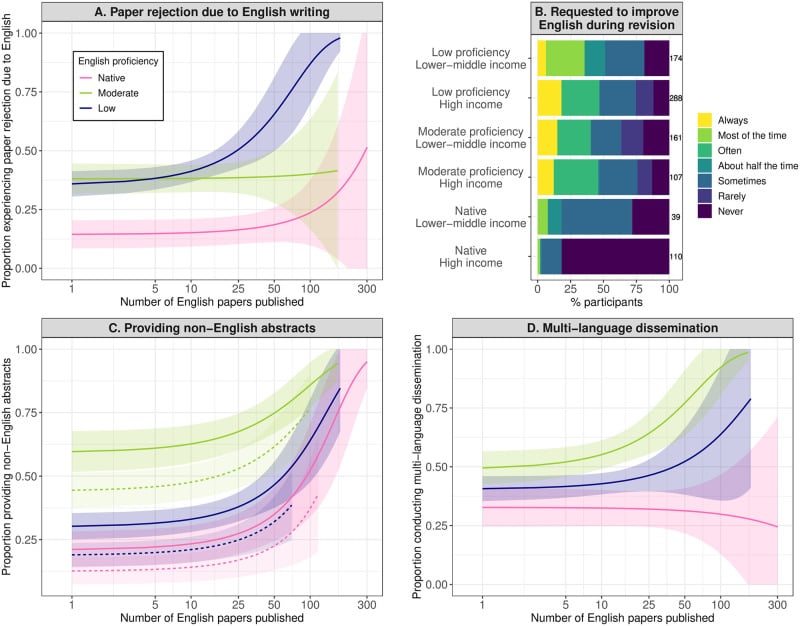
Non-native English speakers, especially those of low English proficiency nationalities, are more likely to have their papers rejected by journals due to English writing, compared to native English speakers.
For example, in a comparison of those who have published one English-language paper, 38% and 36% of the non-native English speakers of moderate and low English proficiency nationalities, respectively, have experienced paper rejection due to English writing.
Only 14.4% of the native English have been rejected for the same reason, meaning that the frequency of language-related paper rejection is 2.5 to 2.6 times higher for non-native speakers as per an article published in PLOS Biology.
Similarly, non-native English speakers are 12.5 times more likely to be requested to improve their English writing during paper revision than natives, that is 42% compared to only 3.4%.
The Time Cost
Activities of disseminating scientific research take more time for Non-native English speakers since they have to do it in multiple languages be it through the publication of their work in non-English-language journals, preparation of non-English-language abstracts of English-language papers, or outreach activities in two or more languages.
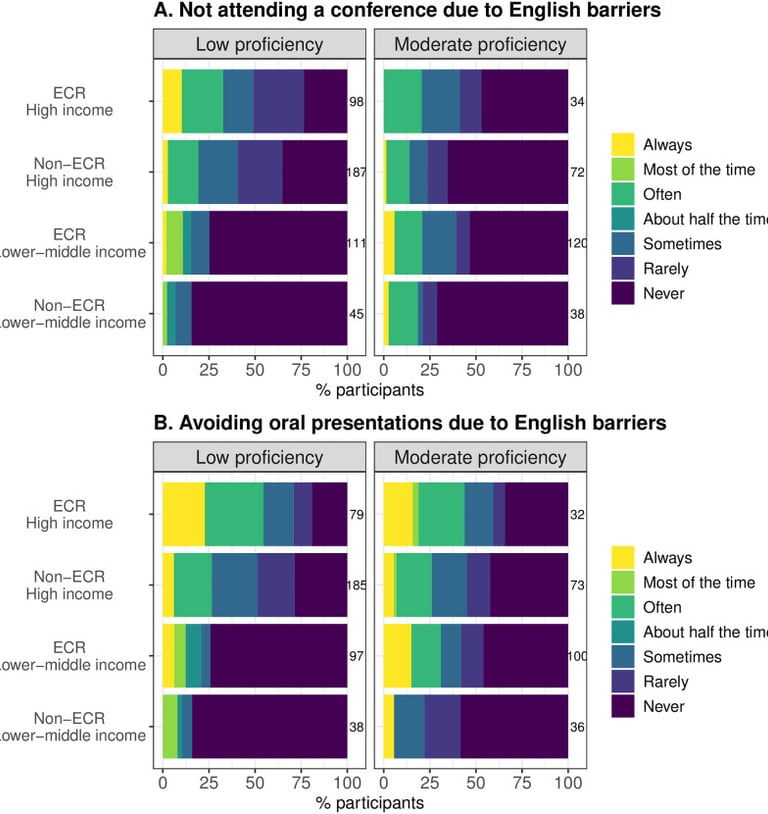
Attending conferences might be one more major barrier to non-native English speakers, since approximately 30% of the early-career non-native English speakers of high-income nationalities report that they often or always decide not to attend an English-language conference due to language barriers.
Similarly, about half of the early-career non-native English speakers of high-income nationalities often or always avoid oral presentations due to language barriers.
Even if they decide to give an oral presentation in English, non-native English speakers need much more time to prepare the presentation than native English speakers do.
Is Language Actually the Reason or Just the Symptom?
Even though there are many testimonies and data about hardships of non-English speakers, it would be unfair to present the other side of the coin too.
An article titled “Academic publishing and the myth of linguistic injustice” published in Journal of Second Language Writing and authored by linguist Ken Hyland, argues that framing publication problems as a crude Native vs. non-Native polarization not only draws on an outmoded respect for ‘Native speaker’ competence, but serves to demoralize EAL (English as an Additional Language) writers and marginalize the difficulties experienced by novice L1 English academics.
He continues his argument calling theheory outdated, too harsh and reductionistic since English serves as lingua franca which means that it is being used by researchers from different linguistic and cultural backgrounds, often with very high level of competence and that whether English is the first language or not does not really play a crucial role. Prof. Hyland says that non-native authors can have decades of writing and publishing scientific work while native speakers often do not have developed skills for academic discourse specific to certain disciplines. In other words, the capability for successful academic writing depends much more on discipline knowledge, experience in publishing and understanding of rhetoric conventions.
Pushing forward the idea of “language inequality” might discourage non-anglophone authors from scientific publishing because it internalizes the idea that they are right from the start in a subordinate position.
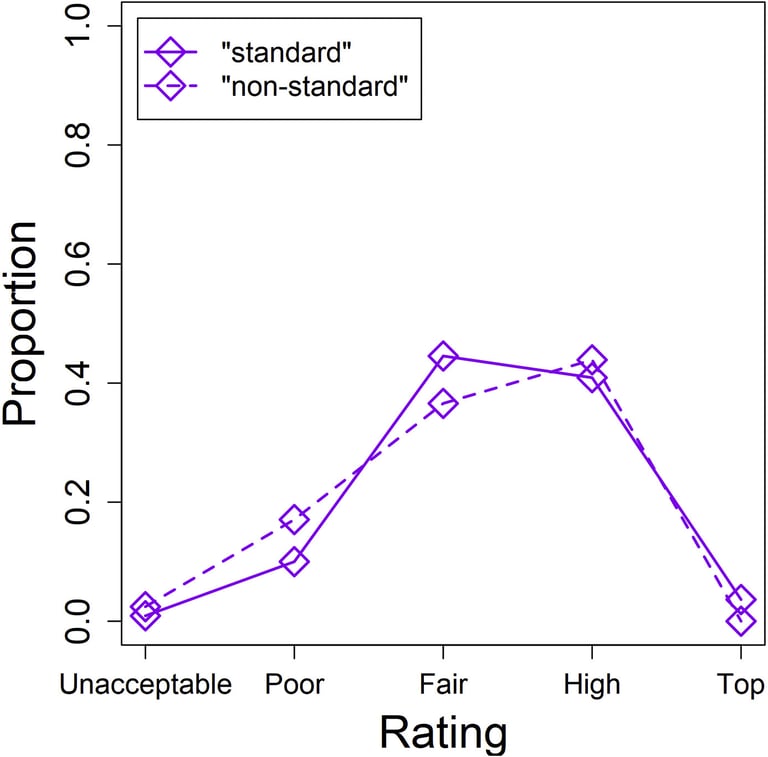
On the other hand, more recent paper titled “Preliminary evidence of linguistic bias in academic reviewing” published in Journal of English for Academic Purposes conducted randomized control study in which scholars judged the scientific quality of several scientific abstracts. Each abstract had two versions with identical scientific content, such that the language in one version conformed to standards for international academic English, and the language in the other version did not (but was still comprehensible).
While the data in the article was preliminary and the effects statistically inconclusive, both pre-registered and exploratory analyses of the data suggested that scholars may give abstracts lower ratings of scientific quality when the writing does not conform to standards of international academic English.
The Specific Language Problems that Trigger Rejection
One of the most frustrating rejection comments is the one telling you that your language is not good enough:
“The manuscript requires extensive English language editing before it can be considered for publication.”
The instinct is to run the text through a grammar checker, or ask a native-speaking colleague for a quick read. But many authors who do this find themselves facing the same comment on their next submission.
The reason is what reviewers call a “language problem” is rarely a grammar problem. It is almost always a problem with how scientific arguments are expressed. Logic, precision, and coherence at the paragraph and section level are crucial in the decision to reject a paper . Even if your sentence is grammatically correct, it may not pass, and that is why grammar checkers are not enough.
We will cover the five most common writing issues in medical and life science manuscripts from non-native English speakers.
1. Overstatement
Even though it may not seem like it, claims you make in English can get your manuscript rejected if they go beyond the numbers that should support them.
High-impact English-language journals are especially sensitive to this issue, which represents one of the most common cases.
Example:
Our findings prove that gene A controls the development of condition B and will revolutionize the treatment of patients with disorder C.
Problems:
"prove" is almost never appropriate in empirical research; use "suggest" or "provide evidence that";
"controls" implies complete and exclusive regulatory authority, which a single study cannot establish; consider "is associated with" or "may play a role in";
"will revolutionize" is a speculative promise stated as certainty; rephrase as "these findings may open new directions for" or "could inform future approaches to".
Solution:
Our findings suggest that gene A plays a role in the development of condition B and may inform future therapeutic approaches to disorder C.
2. Passive Voice: Overuse and Misuse
While passive voice belongs in the Methods section, overusing it in the Results and Discussion makes the writing feel impersonal and makes it hard to follow the logical subject of each argument.
Example:
It was observed that the compound inhibited cell growth. The data were interpreted as indicating a dose-dependent response. It is proposed that the mechanism involves receptor blockade.
Problems:
Every sentence conceals who observed, interpreted, and proposed. The reader loses track of whether these are the authors' conclusions, established facts, or speculative inferences.
Solution:
We observed that the compound inhibited cell growth. The data indicated a dose-dependent response. Our results suggest that this effect may be mediated through receptor blockade.
Conclusion:
Passive in Methods is fine. As for Results, prefer an active voice when presenting your own findings. Discussion: use active ("We observed," "Our data suggest"), as it signals ownership of your interpretation and makes the argument easier to follow.
3. Lack of Cohesion Between Paragraphs
Even when each paragraph is clearly written on its own, a Discussion that lacks explicit transitions between ideas comes across as a series of isolated observations rather than a coherent scientific argument.
Example:
Our study found that receptor B was overexpressed in patients with poor clinical outcomes. Receptor B has been shown to activate the MAPK signaling pathway. Blocking receptor B with a selective antagonist reduced cell migration in vitro.
Problems:
Three sentences and three disconnected observations. The reader is left to infer why these facts belong together and what conclusion they are meant to support.
Solution:
Our study found that receptor B was overexpressed in patients with poor clinical outcomes, aligning with its established role in activating the MAPK signaling pathway. Critically, blocking receptor B with a selective antagonist reduced cell migration in vitro, suggesting that its overexpression actively drives invasive behavior rather than simply marking disease severity.
Conclusion:
Each sentence in a Discussion paragraph should either (a) state the finding, (b) connect it to prior literature, or (c) interpret its significance, and the connective tissue between these moves should be explicit: "aligning with," "critically," "in contrast," "this suggests that," "taken together."
4. Inconsistent Terminology
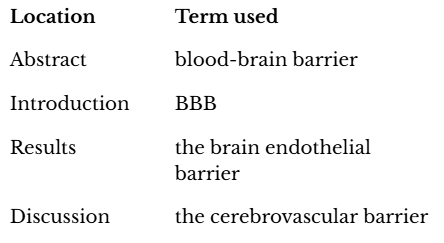
When the same concept is referred to by three different names across a manuscript, which is often the result of multiple authors or merged drafts, reviewers are left wondering whether these are actually distinct entities or simply inconsistent labeling.
Example:
Solution:
Choose one primary term per concept and use it consistently throughout;
Define abbreviations on first use: blood-brain barrier (BBB), then use BBB exclusively;
Check transporter names, receptor designations, and cell type labels for consistent capitalization and formatting (e.g., P-glycoprotein, not p-glycoprotein or P-Glycoprotein in alternating sections).
5. Vague Language
Few things erode a reviewer's confidence more quickly than vague adjectives and adverbs. In scientific writing, every evaluative term needs to be grounded in specific data or a clear point of comparison, otherwise it signals imprecision rather than rigor.
Example:
The tumor volume in the treated mice was considerably smaller, and the survival rate was notably better compared to untreated animals.
Problems:
"considerably smaller": smaller by how much? Compared to which group?
"notably better": better by what measure? Statistical or clinical significance?
neither claim is supported by any quantification
Solution:
Tumor volume in the treated mice was reduced by 58% compared to untreated controls at day 21 (p < 0.001, Mann-Whitney U test), and median survival was extended from 18 to 31 days.
The rule:
Flag every instance of considerably / notably / substantially / markedly / slightly / dramatically / clearly in your manuscript. For each one, ask: can this be replaced with a specific number, comparison, or defined criterion? If yes, replace it. If not, delete it.
What This Means Practically, and What You Can Do
Getting a professional academic editor is not a shortcut around writing, it is the same step native English speakers in non-Anglophone fields routinely take. The difference is that for non-native speakers it is more of a necessity than a polish.
Basic proofreading catches spelling errors and grammar mistakes, but it will not tell you that "demonstrate" should be "suggest," that your Discussion reads as a list of disconnected observations rather than a coherent argument, or that the same concept appears under four different names across your manuscript. It will not flag "considerably smaller" and ask you what the actual number is. Discipline-specific academic editors understand what reviewers in your field expect. It is not just about correct English, but about calibrated claims, logical flow, and the kind of precision that makes a manuscript feel authoritative.
Formatting is worth treating seriously before submission since journals increasingly desk-reject manuscripts for non-compliance before a single reviewer ever reads the language. And when a reviewer comments that the English needs improvement, it is more often signaling that the argument itself is hard to follow than just about vocabulary.
The data and testimonies are real. You should not feel less confident, nor should you abandon your research projects because you do not feel comfortable enough using English.
We, at Quillcademia, stand behind your science and we’re here to help you break through language barriers and avoid language-related rejections.
Professional Human-Only Academic Editing Services for Researchers Worldwide
© 2026.
All rights reserved.