Mladen Rajic CEO Quillcademia | Academic Editing
Read our exclusive interview with Mladen Rajic CEO Quillcademia. Learn how human-only academic editing empowers international researchers to publish in top journals.
Radomir Grcic
5/18/20265 min read
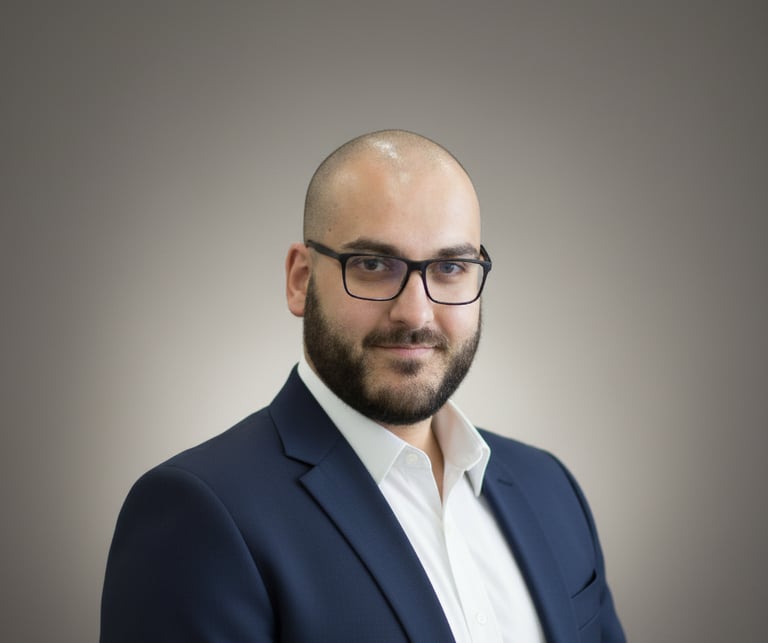
Mladen Rajić, CEO of Quillcademia, spent five years at MDPI, one of the world's leading open access publishers, working closely with researchers from around the world. Over time, he kept noticing how talented scientists were spending more of their time on the language side of their papers than on the research itself. That observation eventually grew into Quillcademia, a company built around the idea that researchers should be able to focus on their science, while our human experts take care of the language.
1. You spent years working closely with researchers and saw the problem up close. When did you realize this could actually become a company?
To be honest, I did not think about this idea right away. Quillcademia gained structure after we decided to pivot one of my "Business English sessions for professionals" ideas. The main assumption was that there are some factors that slow down the procedure of publishing science, and the question was what causes those desk rejections. Soon enough we had our research telling us that language is one of the main variables in that process. Examples of good and bad practices were all around us. The only thing we had to do was connect the dots and implement organizational structure to a well-established market. It all looked good on paper but it required validation. We decided to survey researchers to get some feedback on the idea. At that point it was just a concept. Soon we realized that we had a lot of "runway" in front of us, so we could plan our take-off accordingly.
2. Was there a specific moment or a specific researcher that made you think "okay, I need to
solve this"?
Rather a bunch of moments that piled on, giving me a series of those "aha" moments. I would say that it is better to have more "brains" engaged in analyzing and solving one issue than having just one. So, I collected feedback from my peers and then a joint decision was made: "We need to act on this!"
The thing that annoyed me the most was the stats we got from the research of papers that were written engaging with the subject of SDGs or including the topic. Since I originally came from an Environmental Sciences background, this really pushed my buttons.
3. If you had to explain what we do to someone who has never published a research paper, how would you
put it?
I had this unravel right in front of my eyes. I was in the park with my wife and her nephew (2 years old). The kid approached us and tried to explain something to us, but his words were mixed up. Out of sheer excitement, he could not put the words in the right order, nor could he pronounce them correctly.
So, he had something exciting to tell us, his language capacity was not matching the situational circumstances, but I believe his peers (other 2-year-olds) could understand him to some extent.
I imagined this must be how some researchers feel when they try to communicate their research to a global community of high-level peers. The logic is there, the science and the knowledge about the topic, but language plays a far more important role to simply be neglected in the process.
Disclaimer: I am not comparing the researchers of the world with 2-year-olds; the reference only goes to my framing and understanding of the issue and communicating it to wider audiences.
To experience how our specialized editorial team can help polish your paper, explore our tailored Academic Editing Services.
4. Why did you go with human experts only, when AI
tools are everywhere right now?
From the start, I had my own doubts about the quality of AI work in this sphere. I went deeper into prompt delivery analysis, AI hallucinations, and the main setup of AI, which purely focuses on delivery rather than doing a thorough examination of all quality factors.
Needless to say, there are recent findings on papers written or edited by AI that hallucinated the entire science and references behind them.
I do not deny that at some point AI will advance to a level of quality that may fill this gap, but it is not now, nor do I think it will be that soon. On the other side, science needs to progress.
5. What is the biggest misconception about how non-native English speakers experience language in their research?
I would say that one of the biggest misconceptions was proven during our analysis. The claim — "If your science is good, there is nothing to be afraid of. Your paper will not be rejected purely on the basis of academic language" — turned out to be way off the real situation, where statistics and practice paint a very different picture.
6. How do you explain to someone who has never heard of us that they can send us their work and not worry?
For starters, it is always difficult to tell a researcher not to worry about giving their work into someone else's hands. It is like sending your child to kindergarten for the very first time, or lending your car to your 18-year-old niece. It comes with tons of anxiety, but it builds character and shows a willingness to improve on multiple fronts. You know that I exaggerated with these examples, but trust me, this is the type of emotional energy we sense when we receive papers.
Luckily, everything we receive is saved in its original form so the author can track changes that have been made to their work. To provide additional assurance, we offer free abstract editing so you can get a taste of our work on a smaller sample. If that is not enough, there is a money-back guarantee to make you feel even safer.
But those are safety measures and airbags we have set up. On the other side, you may see things running smoother than usual once we deliver our work. To be precise, you may first notice that your manuscript was not desk-rejected, at least not for reasons of language (that happens more than you can imagine). Then the paper goes through review cycles much more quickly because everyone understands everything clearly. The paper was also formatted to the journal of your choosing, less work for the in-house editors. Plus, there are no additional costs for further language editing, because yours is already perfect.
7. What has building Quillcademia taught you about yourself?
Until now I have learned a series of lessons about patience and people. This experience has helped me to prioritize accordingly and practice my open-minded approach to problem solving. Not all things are just as they seem at first glance. I have deduced that I am more resilient to quick shifts in the market, but also that I need to work more on understanding people's psychology and recognizing their motives.
8. What would you say to a researcher who is sitting tonight, struggling with their English before submitting a paper?
Please stop tormenting yourself with this task and leave it to us. Your focus deserves to be pointed at other things. Look at this as a long-term investment, because it will pay off multiple times through time saved, money saved, and focus preserved for your career and work.
Ready to Elevate Your Academic Publishing Journey?
At Quillcademia, our mission is to ensure language barriers never stand between groundbreaking science and top-tier publication. Submit your abstract for a free evaluation or get in touch with our team today.
Professional Human-Only Academic Editing Services for Researchers Worldwide
© 2026.
All rights reserved.